Our facility is located on the main level in Pleasantview Shopping Centre. We are in a brand new bright, spacious, well planned facility . We have 5 rooms: 2 baby rooms, 2 toddler rooms and a PreK/Kindergarten room.
Our daily routine for each room is similar, however the types of activities varies depending on the age.
Daily Routine
| 7:00a.m.-8:15 a.m. | Free play |
| 8:15a.m.-8:30a.m. | Morning snack |
| 9:00a.m. – 11:00a.m. | Structured activities/all activity centers open/ outdoor play |
| 11:00a.m.-12:00p.m. | Lunch, wash-up |
| 12:00p.m.-2:30pm | Naptime/quiet time |
| 2:30p.m. -3:00p.m. | Afternoon Snack |
| 3:00p.m.-4:30p.m. | Structured activity/outdoor play |
| 4:30p.m.-5:30p.m. | Free play – child pick-up |
Every week we plan activities based on FLIGHT and Schemas that children have been showing interest in. This gives the children new learning opportunities, to explore Our staff observe the children’s interests and introduce these as weekly planning. To summarize – Schema in play refers to the repetitive patterns of behavior and thinking that children exhibit during their play experiences. These patterns reflect the child’s cognitive development and understanding of the world around them. Understanding and recognizing these schemas can help create powerful play spaces that cater to children’s individual learning styles and promote their overall development.
By spotting and understanding schemas in play, educators can create powerful play spaces that cater to children’s individual learning styles. They can provide materials, activities, and experiences that align with the specific schemas children are exhibiting, allowing them to explore and develop their understanding further. This approach promotes children’s cognitive development, fosters their engagement in meaningful play, and supports their overall learning and growth.
Schemas include:
- Transporting Schema
- Trajectory Schema
- Containing Schema
- Enveloping Schema
- Connecting Schema
- Transforming Schema
1. Transporting Schema
Transporting schema involves the exploration and understanding of objects and their movement from one place to another. Children with a transporting schema often engage in activities such as carrying toys, pushing objects, or moving items around. Ever noticed how some children love to fill handbags and purse and carry bits and bobs around the setting?
This schema allows children to develop their coordination, spatial awareness, and problem-solving skills. As they engage in transporting schema activities, they learn about weight, balance, and cause-and-effect relationships. For example, a child may discover that a heavy object is more challenging to carry than a lighter one or that pushing a toy car harder makes it go faster.
Through transporting schema, children develop an understanding of object permanence, which is the concept that objects exist even when they are out of sight. This schema also promotes imaginative play, as children often incorporate transporting activities into their pretend play scenarios, such as pretending to be a delivery person or a construction worker.
2. Trajectory Schema:
Trajectory schema is another cognitive framework that emerges during early childhood. It involves children’s fascination with the path and movement of objects, particularly in a linear or curved motion. Children with a trajectory schema may enjoy activities such as throwing objects, rolling balls, or watching the movement vehicles and toy cars. Children who have a fascination with running water or knocking over of blocks, the compulsion of running down corridors can mistakenly be considered as negative behaviour, but children may just have that URGE FOR MOVEMENT, momentum. Exploring the force, speed and movement of themselves and things.
Through trajectory schema, children learn about speed, distance, and direction. They experiment with different angles and forces to understand how objects move in predictable ways. For instance, a child might observe that throwing a ball at a higher angle makes it go higher, or that rolling a toy car down a ramp makes it go faster.
This schema also contributes to children’s understanding of cause and effect. They learn that specific actions result in predictable outcomes. Furthermore, trajectory schema encourages children to engage in physical activity, helping them develop their gross motor skills, coordination, and spatial awareness.
3. Containing Schema:
The containing schema manifests as a fascination with enclosing objects and spaces. Children with this schema are captivated by the act of putting objects into containers, building forts, filling and emptying. Through these repeated behaviours, they explore the concepts of containment, boundaries, and spatial relationships.
According to Dewey (1916), “Children exhibiting a containing schema often engage in activities that involve organizing objects into boxes or creating structures that provide a sense of enclosure.” This behavior reflects their intrinsic desire to comprehend the notion of containment and its implications.
4. Enveloping Schema:
The enveloping schema involves a child’s enchantment with wrapping, covering, or hiding objects and themselves. They may engage in activities such as wrapping toys in blankets, hiding under bedsheets, or creating imaginative hideouts. Through these repeated behaviours, children explore concepts of concealment, protection, and transformation.
Piaget (1952) illuminates this schema, stating, “The enveloping schema represents a child’s desire to create a secure and transformative space. It allows them to explore the world around them, making connections between objects and their physical properties.” This behaviour unveils their innate curiosity and their quest to comprehend the world through their personal actions.
Children way also have an urge to paint themselves.
5. Connecting Schema:
The connecting schema revolves around children’s fascination with linking and joining objects, ideas, or experiences. During play, children with this schema may engage in activities such as building intricate structures with blocks, creating elaborate storylines that interconnect various characters and events, or assembling puzzles. Through these repetitive actions, they explore the concept of connections, patterns, and cause-and-effect relationships.
Athey (2007) emphasizes the significance of the connecting schema, stating, “Children exhibiting a connecting schema often demonstrate a strong desire to link and combine elements in their play. They may enjoy activities that involve building, sorting, or creating narratives with interconnected plotlines.” This behavior showcases their innate drive to make sense of the world by establishing meaningful relationships between various elements.
6. Transforming Schema:
The transforming schema revolves around children’s fascination with change, metamorphosis, and the exploration of cause-and-effect relationships. During play, children with this schema may engage in activities such as pouring and mixing substances, experimenting with different materials, or engaging in dramatic play where they transform into various characters. Through these repeated behaviors, they explore concepts of transformation, states of matter, and the consequences of their actions.
Piaget (1952) highlights the transformative nature of play for children with this schema, stating, “The transforming schema allows children to explore the world by manipulating materials, observing changes, and understanding cause-and-effect relationships. It empowers them to see the possibilities of transformation in their surroundings.” This behavior or reflects their innate desire to experiment, discover, and witness the power of their own agency.
ROOMS
Baby Room #1 (9 months to 19 months)
Our infant room is licensed for 8 children aged 9 months to 19 months. We have two staff members in this room.
Staff offer a safe and secure play space that meets each baby’s individual needs. Flexibility and understanding of infant feeding and sleeping schedules are a priority.
Activities may include:
- Free play
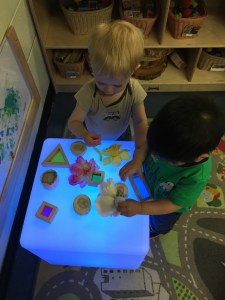
- Art ( ie. Finger painting)
- Water table
- Storytime
- Dramatic area/ light table
- Sensory table
- Baby signing (practicing with songs and simple words)
- Outdoor play (gross motor area)
- Music class once/twice a month
Parents receive a daily report thru Lillio detailing their child’s activities that day.
Baby Room #2 (12 months to 24 months)
Our baby room #2 is licensed for 12 children aged 12 months to 24 months. We have three staff members in this room.
Staff offer a safe and secure play space that meets each baby’s individual needs.
Relaxed routine and sleeping schedules are a priority.
Activities may include:
- Free play
- art ( ie. Finger painting)
- Water table
- Storytime
- light table
- sensory table
- dramatic area
- Playing with balls
- Baby signing (practicing with songs and simple words)
- Outdoor play (2 spacious areas)
- Music class once a month
Parents receive a daily report thru Lillio detailing their child’s activities that day.
Toddler Room #1 (2-3 years)
Our toddler room #1 is licensed for up to 30 children aged 2-3 years. We have 2 staff members (up to 5) in this room.
Staff ensure a warm and loving environment and follow simple rules of:
- Walk inside
- Use quiet voice
- Encourage them to vocalize their feelings
- Treat others nicely
- Treat objects nicely
Activities may include:
- C(finger painting, play dough, learn to use child scissors)
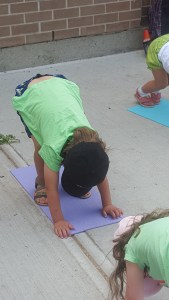
Outside Yoga - Free play
- Dance
- Circle time (reading)
- Outdoor play (facility playground)
- Music class once a month
Parents receive a daily report thru Lillio detailing their child’s activities that day.
Toddler Room #2 (3 to 4 years)
Our toddler room #2 is licensed for up to 24 children aged 3 & 4 years. We have up to 4 staff members in this room.
Staff ensure a warm and loving environment and follow simple rules of:
- Walk inside
- Use quiet voice
- Encourage them to vocalize their feelings
- Treat others nicely
- Treat objects nicely
Activities may include:
- Art (finger painting, play dough, learn to use child scissors)
Outside Yoga - Free play
- Tuff tray/ sensory play
- Light table play
- yoga twice a month
- Circle time (reading)
- Outdoor play (grassy area and gross motor area)
- Music class twice a month
Parents receive a daily report thru Class Dojo highlighting their child’s activities that day.
PreK Room: ages 4 to5 years old
We are set up for 30 children with 3 staff members.
In this room children naturally strive to be independent, and we help them travel this road.
Patience, encouragement and love are needed to help teach them to be assertive and expressive. Some simple rules include:
- Walk inside
- Use a quiet voice
- Encourage them to vocalize their feelings
- Treat others nicely
- Treat objects nicely
Activities in this room include:
- Free play
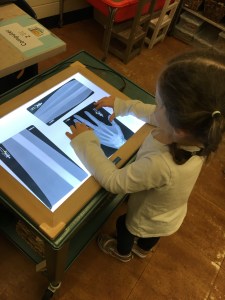
Examining X-rays of Bones on the Light Table - Crafts ( paint with brushes, drawing)
- Literacy ( story time)
- Baking (cookies, cupcakes – with )
- Dramatic play (Market stand)
- yoga twice a month
- Math skill development (counting, sorting)
- Music class twice a month
- Outdoor play (own outdoor space, with ramps, tires, balls, tuff trays))
- Whitemud Crossing librarian visits for storytime
Parents receive a daily report thru Class Dojo highlighting their child’s activities that day.
 Mckee Child Care Centre